WORK: Civil Complaints

It may not always be possible to pursue animal cruelty on a specific case. Even if information suggests there may be animal neglect or cruelty occurring, sometimes access to a property to assess or verify conditions is not possible within the law.

Animal Folks will also use civil laws to protect animals, appealing to authorities to take action based on a permit, license, or other civil law that may be violated.

Part of our process is to act as a watchdog. By requesting inspection reports of licensees who handle animals, for example, we are able to see what goes on "behind closed doors" and if a licensee is compliant.
Picture
This is why proper enforcement efforts and data transparency by government is important for the protection of animals and the accountability of authorities.

NOTE: Two case examples are provided below to show complexity of these kind of cases. As with enforcement of criminal law, justice may not always be found for animal and human victims. It's best to still file complaints and learn what problems or loopholes existing in the enforcement of civil law so systemic changes may be made.

Examples of civil action

A complaint depends on the specific law that has been violated. Examples:
  • Violation of local permits (i.e., dog breeder operating without a permit); oversight by the city or county
  • Violation of animal exhibitor (i.e., businesses operating in malls displaying fish, birds, or other, typically, exotic wildlife for viewing or touching by the public); oversight by the Department of Natural Resources (DNR)
  • Violation of federal regulatory laws (i.e., violation of license under Animal Welfare Act; operating and selling without a federal license); oversight by the United States Department of Agriculture (USDA)
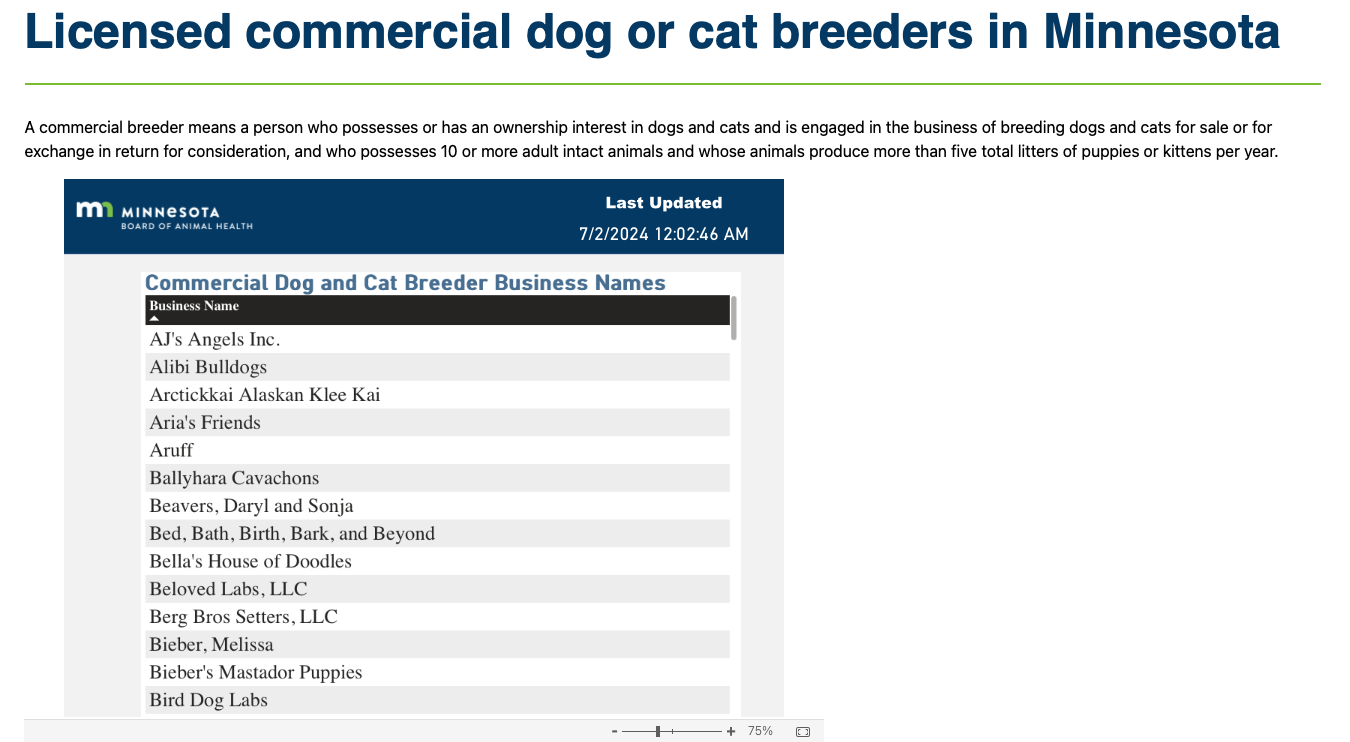
  • Violation of state regulatory laws (i.e., operating without a state license; violation of state license requirements); depends on law; oversight of commercial dog and cat breeder law and kennel and dealer law is through the Board of Animal Health
  • Violation of veterinary duties (i.e., operating as a veterinarian without a license; or unprofessional conduct by a licensed veterinarian); oversight by Board of Veterinary Medicine
  • Violation of consumer protection laws (i.e., purchase of an animal that was fraudulently presented and sold; animal defined as "product"); oversight by Office of MN Attorney General
  • Violation of tax law (i.e., animals are considered to be products and, if sold as retail, sales tax must be collected and remitted to the Department of Revenue); oversight by the Dept.. of Revenue

As animals are defined as property, property laws, including theft, arson, and other laws applicable to the crime, can also be considered when seeking justice for animals.

Environmental laws, labor laws, health laws, and other non-cruelty law may also be pursued depending on the violations and impact caused by the business or individual. For "other" laws, go to: Additional State Laws

EXAMPLE: Consumer Protection Complaints

How animals are treated can impact communities in a variety of ways — from the quality of water, air, soil, labor, disease, and other factors, all impacting people and the environment and not just animals.

One "civil" law that has gained a lot of attention for animal issues are consumer protection laws. Animal Folks, for instance, has been contacted by numerous consumers over the past decade who have purchased sickly puppies from breeders and pet stores.
Picture
Because animals are not often seen as "products" or "property" by the public, sometimes consumer protection laws are not pursued. However, this is when theses laws should be used. If you, as a consumer, feel you were misled (by advertising or the owner/employees of the business) or deceived about what you were told from the retailer, speak up. File a complaint or lawsuit.

Examples of consumer protection laws are below: (Also found at Additional State Laws.)

  • Minn. Stat. sec. 325F.68 - 325F.70 - Prevention of Consumer Fraud Act  (scroll to section)
    As animals are defined as property (i.e. products), general consumer protection laws can apply. This law broadly prohibits "fraud, misrepresentation, deceptive or unfair practices," including false pretense, false promise, and misleading statements.

  • Minn. Stat. sec. 325D.43 - 325D.48 - MN Uniform Deceptive Trade Practices Act (scroll to section)
    This Act prohibits "unfair or deceptive acts in or affecting commerce." If, for instance, a breeder engages in conduct, such has causing confusion about the goods (animals) it sells or representing those goods (animals) with qualities they don't have, that can be defined as deceptive business practices.

  • Minn. Stat. sec. 325F.67 - MN False Statement in Advertisement Act
    False statements in advertising are prohibited under this law, including statements about animals being sold. Advertisements that contain "any material assertion, representation, or statement of fact which is untrue, deceptive, or misleading" would fall under this law.

  • Minn. Stat. chapter 336  Article 2 336.2-315 - Uniform Commercial Code
    If there is a transaction in goods (i.e., selling of animals), Article 2 governs contracts for the sale of goods by a merchant, such as the store owner. This law sets forth implied merchantability; in other words, when selling the goods (animals), it is implied that the goods are suitable or fit (i.e., healthy animals, not sickly) for purpose.


NOTE: Holding a business accountable for violation of the above laws may require hiring your own attorney. The Minnesota Office of Attorney General provides oversight of consumer protection laws. Any suspected violation of these laws should be reported to this office (though they may not act on it; they may direct you to hire your own attorney or work to resolve it with the business). File a complaint either way so that it goes on record; there may be a long list of other complainants which could force action by the state. ALSO: Don't give up. If you are sent a form letter in response to a complaint, pursue it further. Raise questions. Animals are living, breathing, sentient beings — different from a car, computer, or couch. You are their voice.

EXAMPLE: Bold North Frenchies

This is a current case.

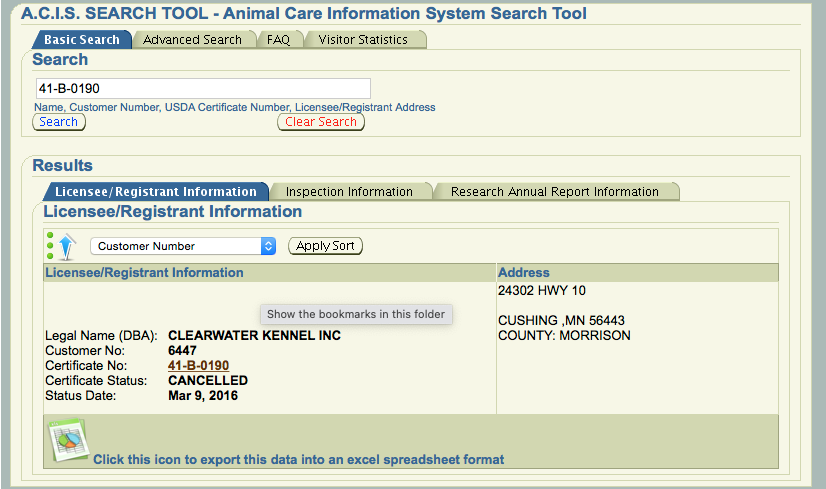
EXAMPLE: Clearwater Kennels, now A.J.'s Angels

Clearwater Kennels was the largest puppy mill in Minnesota — mass producing thousands of puppies and shipping the animals to brokers to be flipped to pet stores nationwide. 

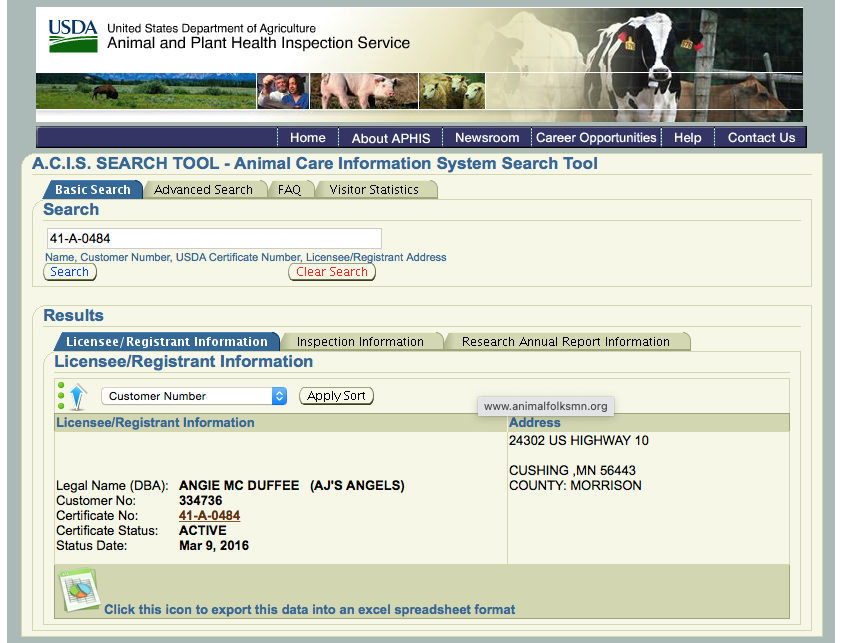
The owner of Clearwater Kennels sold the kennel to her daughter-in-law who now operates the same facility under the name A.J.'s Angels.

In July 22, 2023, inventory counts were reported by the USDA to be 885 dogs and puppies at A.J.'s Angels.
  • In 10-21-21, 1,172 dogs and puppies were reported.
  • In 08-15-19, 1,267 dogs and puppies were reported.
  • In 06-13-18, 1,338 dogs and puppies were reported.
  • In 06-08-17, 1255 dogs and puppies were reported.
  • In 07-13-16, 1,030 dogs and puppies were reported.
Picture
Prior to the name (and ownership) change, Clearwater Kennels had inventory counts of well over 1,000 dogs and puppies for many years (see chart below). In 2010, this kennel had over 1,700 dogs and puppies. This is mass production of puppies to sell to brokers and pet stores nationwide.

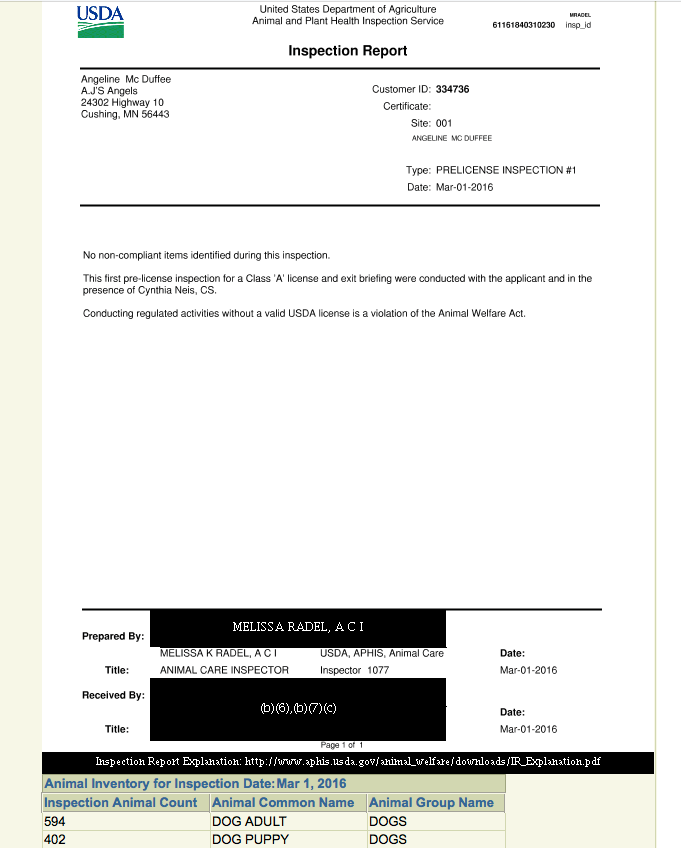
Back in the early days when the USDA recorded violations through its inspections and enforcement of the Animal Welfare Act, multiple violations were noted and photographed at Clearwater Kennels. Below are just a few photos with screen shots of past inspection reports, showing long nails, moldy food, lack of veterinary care, excessive heat. (Additional data is available.)

In March 2015, the USDA filed a complaint against Clearwater Kennel for violation of the Animal Welfare Act. Multiple violations for years were cited against this kennel; however, rather than revoke its federal license and close the kennel due to violation of the law, the USDA entered into a settlement agreement with Wanda Kretzman, the owner, on March 9, 2016. Also on March 9, a kennel on the same property was granted a new USDA license. 

TIMELINE of actions
  • Prior, on March 9, 2016, Clearwater Kennels (owner Wanda Kretzman) cancelled its USDA license.
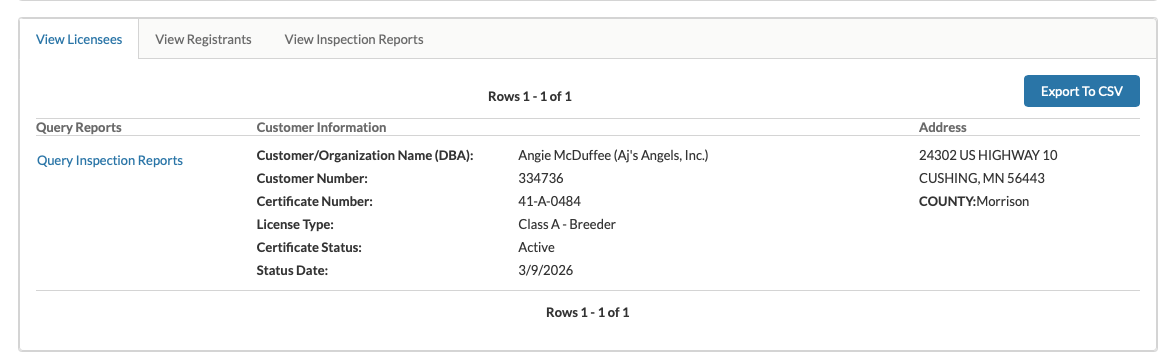
  • Also on March 9, 2016, a USDA license was granted to A.J.'s Angels (owner Angie McDuffee) to operate the kennel on the same property. The owner of A.J.'s Angels, as noted above, is the daughter-in-law of Wanda Kretzman.
  • A state license was also granted at the same time (March 2016) by the Minnesota Board of Animal Health.
  • This kennel continues to operate today.

Supporting Documents
Actions: Animal Folks
When the USDA issued a formal complaint against Clearwater Kennels, Animal Folks and others were relieved that, finally, the USDA was holding this breeder accountable for its multiple violations of federal law over multiple years. However, this joy was short-lived.

As stated above, the USDA issued a Settlement Agreement and Consent Order with Clearwater Kennels in March 2016 which essentially dismissed the violations and, on the same day, granted a license to A.J. Angel's to operate the kennel. (The USDA only penalized the breeder with a small civil fine.) The state oversight board, the MN Board of Animal Health, also granted a state license to the new kennel owner during that same time period in March — so the breeding operations and business activity continued as is.

The (federal) Animal Welfare Act explicitly states that no license can be issued under circumstances that would circumvent federal law:
  • §2.11 (a) (5) Is or would be operating in violation or circumvention of any Federal, State, or local laws;
  • §2.11 (6) (d) No license will be issued under circumstances that the Administrator determines would circumvent any order suspending, revoking, terminating, or denying a license under the Act.

Animal Folks believed actions by the USDA-APHIS, by issuing a license to the new owner (daughter-in-law) on the same day that the former owner's license was cancelled indicated circumvention.
  • We believed the USDA-APHIS erred in not revoking the federal license of Clearwater Water Kennel based on considerable violations of the Animal Welfare Act and
  • We believed the USDA-APHIS erred in granting a new license to their successor, A.J. Angels, Inc..
  • We believed the USDA-APHIS was aware of this transfer and, it appears, may have helped orchestrate this action by expediting the pre-license approval for A.J. Angels to operate. 

As stated in our complaint: We believe the mission of the USDA-APHIS and the intent of the Animal Welfare Act (AWA) are to protect the welfare of the animals. However, by simply allowing for the transfer of Clearwater Kennel, Inc. to a new legal name (A.J. Angels, owned by Angeline McDuffee, daughter-in-law of Wanda Kretzman), while under charges relating to repeated instances of non-compliance with the AWA, the settlement agreement between the USDA-APHIS and Clearwater Kennel appeared to favor the business, not protect the animals.
 
No suspension or revocation was ordered, even though violation of law occurred for decades. The kennel was not closed; the animals are still in the same situation. No conditions were placed within the agreement prohibiting Wanda Kretzman or her employees from working at the same kennel and continuing the same noncompliant managerial practices. Further, Clearwater Kennel was given the opportunity to reapply for a federal license by June 1, 2016 (if the fine is paid and no violations of AWA occur).
 
The parties were instructed to settle. The kennel was and is fully operational — just under a different name. Avoiding a license suspension or revocation under the narrow definition of the federal regulation by using a technicality (i.e., cancelling a federal license and having a direct family member assume the new legal name for the same kennel on the same property) violates the spirit of the Animal Welfare Act.

The USDA took no action per the complaint filed. See comments below.
Gallery image
Gallery image
Gallery image
Gallery image
Gallery image
Gallery image
Gallery image
Top photo is aerial view of A.J.'s Angels (formerly Clearwater Kennels). Other photos from USDA inspection reports when operating as Clearwater Kennels.
Picture
Video of this breeding facility was taken by the Companion Animal Protection Society (CAPS) of A.J.'s Angels. As entrance to the kennel by the public is not allowed, video is from an outdoor view — showing adult dogs in runs, pacing endlessly. Such behavior is common in high-volume kennels and is indicative of psychological problems due to lack of enrichment and socialization.

LINK TO VIDEO: 
CAPS - A.J. Angels

COMMENT
This case occurred years ago but it is included here to illustrate why citizens and animal supporters have been concerned with how federal and state authorities handle regulatory actions and their lack of prioritizing the welfare of animals over business interests.

  • While complaints for federal regulatory violations can be filed with the USDA, action rarely is taken by that office. In June 2021, the Office of Inspector General in its audit of the USDA-APHIS' activities stated: "We found that APHIS did not consistently address complaints it received or adequately document the results of its follow up. This occurred because APHIS does not have a documented process for responding to complaints or for recording the results of the agency's actions. ... Therefore, APHIS is not able to ensure the overall health and humane treatment of animals at these facilities."
  • While complaints against dog breeders for state regulatory violations can be filed with MN Board of Animal Health (who grants licenses and conducts inspections of large dog breeding operations), they too have proven to be ineffective and limited in its actions to properly enforce the breeder law and enhance animal welfare. 

Lessons learned: Take action in other ways:
  • File lawsuits. File complaints. Get it on record. But file lawsuits; don't wait for federal or state authorities to act. 
  • Build awareness of the issue. Promote concerns in the press.
  • Reach out and speak up. Contact your federal or state legislators and ask for their involvement.
  • Challenge the existing power structures at local, state, and federal levels. Introduce new laws or ordinances to change who makes regulatory decisions so as to better protect animals in these facilities. Animal Folks is doing so with the Companion Animal Board bill, which will transfer enforcement authority of the dog and cat breeder law away from the Board of Animal Health and place it with the Companion Animal Board. The welfare and protection of animals is not just about the law itself; it's about who enforces the law.

"The greatness of a nation
and its moral progress can be judged by
the way its animals are treated.
"
- Mahatma Gandhi